Article: Best Coffee Syrup for Home Baristas (And How to Actually Tell Them Apart)
Best Coffee Syrup for Home Baristas (And How to Actually Tell Them Apart)
There was no "Best Coffee Syrup", so I made my own
I spent months looking for the best coffee syrup before I stopped looking and started making my own. Every brand I found had the same problem underneath the marketing: manufactured flavoring compounds and carrier solvents that produce flat, artificial tastes nothing like what's on the label, and an aftertaste that lingers long after the coffee is gone. This guide is the research I wish I'd had. It covers every brand worth knowing about, what's actually on the label, and the only ones doing it differently.
TL;DR
Most coffee syrups, including the ones selling themselves as craft, organic, and natural, are still built from flavoring compounds and carrier solvents that end up in your cup. Only a handful of brands use whole culinary ingredients. Here's the honest breakdown.

By Jonathon Webster, Founder of Bon Brun | August 2026
When I bought an espresso machine, I was just excited to make my wife lattes at home. It was going to win me a lot of praise. Then I bought Torani caramel and it was so flat and metallic I thought something had gone wrong. Plain sugar tasted better.
So I switched to Monin because the community treats it as the natural option. It arrived smelling like cheap rum. I bought a five-pack sampler thinking one of them had to be good. They all had the same problem: the flavor wasn't reading strongly, but there was this thin metallic quality to all of them that left a weird aftertaste and a tightening sensation I couldn't shake.
I made my own simple syrup at home with vanilla extract just to see. It came out better than anything I'd purchased, but still had that boozy, flat extract note. I was basically drinking vanilla extract in warm milk.
After enough research I found out why: the alcohol in extracts and the glycerin in natural flavoring compounds both end up in the bottle. They don't cook off. The aftertaste isn't incidental. It's structural. Every brand using these techniques will produce the same result.
From there it was easy to assess the competition. Every craft syrup maker I found was using the same flavoring techniques, which meant none of them would solve the problem. That was genuinely surprising. Every time I thought I'd found someone doing it right based on some claim they were making, more digging would reveal the same thing on the label: natural flavorings, extracts. Every time.
TikTok made this worse. People were pointing at vanilla bean seeds visible in a bottle as proof of authenticity. What most of them didn't know is that manufacturers can use vanilla pods and seeds that have already been extracted, the husks with no flavor left, just to get the visual. It's common in vanilla ice cream. If you're getting real vanilla flavor from whole beans, why do you also need vanilla extract in the ingredient list? The marketing claims kept coming. The labels kept saying the same things underneath them. What's most surprising is when vanilla extract is used along with vanilla beans - that defeats the purpose. Labels by law must list the ingredients in the order of quantity (mass), so if you see extract before the real ingredient, there must be very little of the real ingredient because extract is incredibly concentrated and over-powering.
Here's the breakdown of every brand worth knowing about.
Coffee Syrup Brand Comparison: Ingredients, Carriers, and What They Don't Tell You
For each brand, the first question is simple: does the syrup use a carrier-based flavoring compound (glycerin, propylene glycol, or alcohol extract) that produces aftertaste? Everything else follows from that.
Torani
Carrier-based flavoring: Yes
The category default since 1925. In coffee shops everywhere not because it's the best product but because it flows through existing distributor networks cheaply and consistently. Vanilla, caramel, and hazelnut all have the same structure: "natural flavors" doing all the work, caramel color for visual, sodium benzoate as a preservative. Single-note taste in every expression.
Strengths: Cheap, consistent, widely available, long shelf life.
Weaknesses: Flavoring compounds throughout, sodium benzoate, no depth, metallic aftertaste.
Monin
Carrier-based flavoring: Yes
The community upgrade from Torani, primarily because it doesn't use sodium benzoate. The ingredient approach is structurally the same. Their vanilla adds natural vanilla extract alongside the natural flavoring compound, which is marginally better. Caramel with sea salt is their strongest expression. The salt does something real. Hazelnut has no hazelnut in the ingredient list. The reputation as the "cleaner" option exceeds what the label delivers. Monin French Vanilla tastes like cheap rum - my wife compared it to rompope. After talking to customers. in my research phase, I found it was incredibly common to have 3-4 bottles of Monin from the store, with only one being ok enough for a coffee, and the others sitting in a cabinet for an occasion that never arrives (who wants to give this to their friends?!).
Strengths: No sodium benzoate, wider range, caramel with salt is decent.
Weaknesses: Still flavoring-compound based throughout, boozy vanilla note, carrier aftertaste present.
1883 Maison Routin
Carrier-based flavoring: Yes — artificial and natural flavors
French brand, glass bottle, premium pricing, strong presence in specialty cafes. The Alpine origin story and "Made in France" positioning are compelling. Then you read the label.
Vanilla: Cane Sugar, Water, Artificial Flavor, Natural Vanilla Flavor, Color: Caramel. Both artificial and natural flavoring compounds. No vanilla source named.
Hazelnut: Cane Sugar, Water, Artificial Flavors, Color: Caramel. Straight artificial flavoring. The brand's own product description calls Alpine water their "secret ingredient" which is doing a lot of work to distract from what's actually flavoring the syrup.
Strengths: Attractive packaging, strong cafe presence, wide flavor range, glass bottle.
Weaknesses: Artificial flavoring throughout, worse than Torani and Monin on ingredient honesty, premium positioning not supported by the label.
Holy Kakow
Carrier-based flavoring: Yes (extract-based)
Organic, small-batch, handcrafted in Oregon. The Colombian sugar is genuinely interesting, rich in molasses and darker in character than standard cane sugar. They're transparent about using "extracts made from real foods" which puts them a step above Torani and Monin on honesty, but still in extract territory. Himalayan salt and citric acid for preservation. No artificial preservatives, which means some separation can occur and shelf life is limited compared to preserved syrups. The organic positioning and genuinely small-batch production are real differentiators at the cafe wholesale level. The extract base means the same carrier aftertaste issue applies, though the quality of the extracts may be higher than mass-market brands.
Strengths: Organic, genuinely small-batch, transparent about extract use, interesting sugar base, no artificial preservatives.
Weaknesses: Extract-based flavoring, carrier aftertaste present, separation occurs, limited shelf life, lacks body.

Portland Syrups
Carrier-based flavoring: Yes, though less than most
Genuinely small-batch, organic sugar, honest short ingredient lists. Their caramel actually caramelizes the sugar first before adding an organic caramel flavoring compound. A real process step that creates better base flavor than pure flavoring systems. Their vanilla names the extract source (Tahitian beans in cane alcohol) rather than hiding behind "natural flavors." The hazelnut contains no nut allergens. That tells you what's actually in it. The notably higher citric acid creates a bright, tart profile that works well for cocktails and cold brew. In a hot milk-based latte that acidity is more noticeable. No preservative means refrigeration is required, which limits counter display and shelf life. Lacks the body that comes from a more complex syrup base.
Strengths: Transparent sourcing, real caramelization on caramel, organic, genuinely small-batch.
Weaknesses: Still extract and flavoring compound based on most expressions, acidic profile better suited to cocktails than lattes, refrigeration required, lacks body.
Surrup
Carrier-based flavoring: Yes
Prominent in Google ads, attractive square bottle, bold branding. The "whole ingredient" positioning sounds compelling until you check the labels. Their toasted marshmallow uses a marshmallow flavor concentrate. Their hazelnut praline uses an organic hazelnut flavor concentrate. Their vanilla is pure cane sugar, water, natural flavors, citric acid. Identical structure to Torani at a similar price point to Bon Brun. They do use real spices in some expressions. Actual cinnamon in the cinnamon bun, for example. But spices are the easy part. The core coffee flavors that most people buy syrups for are still built on flavoring compounds and carrier solvents. At this price point, you can do significantly better.
Strengths: Creative novelty flavors, attractive packaging, some expressions use real spices.
Weaknesses: Core coffee flavors built on flavor concentrates, vanilla is Torani-equivalent at premium pricing, carrier aftertaste present throughout.
Sonoma Syrup Co.
Carrier-based flavoring: Yes, mild
Their vanilla bean syrup lists Madagascar Bourbon and Tahitian vanilla extract alongside vanilla beans and seeds. The extract is doing the primary flavor work, the beans add the visible specks. The extract quality is genuinely higher than mass-market brands. Their caramel uses actual caramelized sugar rather than caramel color. That's a real step up from the field. Still an extract-primary product. The alcohol character is present in hot drinks. Nothing in the formulation adds body to the syrup in espresso.
Strengths: Higher-quality extract sourcing, honest labeling, real caramelization on caramel, premium positioning.
Weaknesses: Extract-primary on vanilla, alcohol character in hot drinks, lacks body.
Williams Sonoma House Brand
Carrier-based flavoring: Yes
Their vanilla bean uses pure vanilla extract as primary, beans added for visual. Their salted caramel lists "vanilla flavor" and "caramel flavor" as manufactured compounds. Not a great look for a product in a premium retailer. The agave adds a mild sweetness that gives it a slightly different character from pure cane sugar syrups, but the foundation is flavoring compounds throughout.
Strengths: Widely available, agave adds mild complexity.
Weaknesses: Flavoring-compound based, salted caramel lists artificial flavoring descriptors explicitly, lacks body.
Pink House Alchemy
Carrier-based flavoring: No (genuinely whole ingredient)
A legitimate option. Based in Arkansas, their syrups appear to be genuinely ingredient-based: fruit, herb, and spice expressions built from actual source ingredients. Transparent and real. The practical limitations matter for daily use. Refrigeration is required and shelf life is limited. Not the countertop staple that a daily ritual calls for. The formulation lacks the body that a more complex syrup base creates in espresso drinks. Worth noting for people who prefer no preservatives or need to avoid gluten. No salt, so the caramel comes up surprisingly flat. A bit thin and watery.
Strengths: Genuinely whole ingredient, no flavoring compounds, clean label.
Weaknesses: No preservative means limited shelf life without refrigeration, lacks body, design is not very counter-worthy
Transcendence Coffee
Carrier-based flavoring: No (genuinely whole ingredient)
Founded by two engineers who were frustrated with artificial syrups. Their Madagascar Vanilla Bean is Water, Pure Cane Sugar, Madagascar vanilla bean. Three ingredients. Their Miso Salted Caramel uses real miso paste and real vanilla bean. No extracts, no concentrates, no natural flavors. The ingredient honesty is real. The flavor range is adventurous rather than traditional. Globally-inspired expressions like Gulab Jamun and Baklava alongside more accessible ones. A great option if you want something genuinely crafted and fun to explore. In my opinion, the formulation still lacks body in espresso drinks, has no salt to help carry the flavor and the flavor range doesn't cover the classic coffee shop staples as a primary offering.
Strengths: Genuinely whole ingredient, no extracts, honest label, interesting flavor range, approachable price.
Weaknesses: No preservative means limited shelf life without refrigeration, Lacks body and salt. Flavor range skews adventurous, not the rich traditional staple for daily vanilla or hazelnut use.
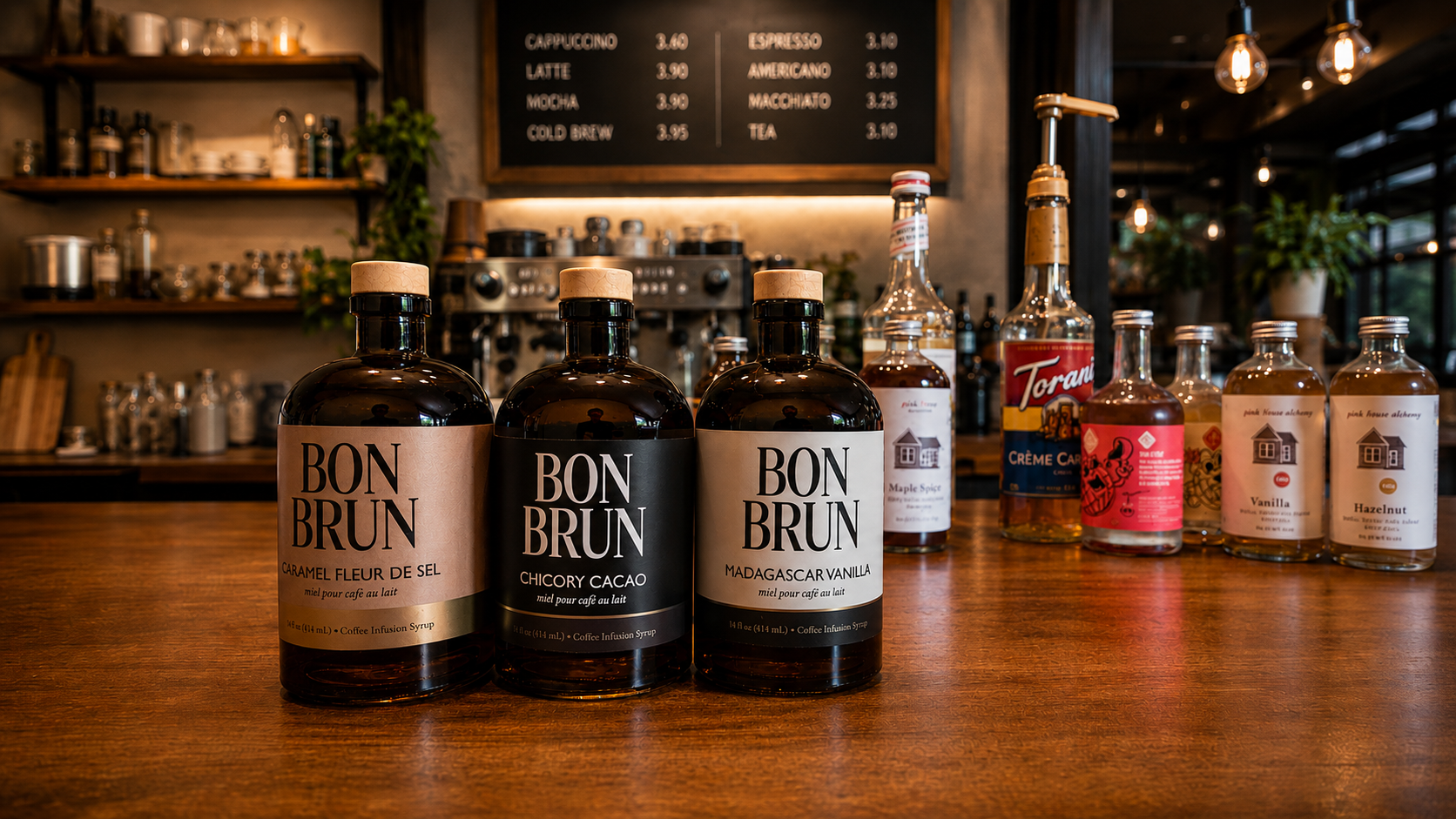
Bon Brun
Carrier-based flavoring: No
Full disclosure: this is my brand. Every expression is built from whole culinary ingredients. Grade A vanilla beans steeped whole, seeds and pods, natural fats and oils, no extract. All syrups are finished with French sea salt creating a smooth finish instead of a weird aftertaste. Bon Brun is the only hazelnut syrup in this guide built from actual hazelnut praline sourced from France. Maple Pecan uses Millican Pecan butter from San Saba, Texas and real maple sugar.
Across the range, Bon Brun pairs each expression with a specific toasted malt selected to give the syrup extra body and depth. The caramel uses caramel malt, while other expressions use biscuit malt, honey malt, or others depending on what the flavor calls for. No other syrup brand does this. It's one of the things that makes Bon Brun noticeably fuller in the cup than anything else in this guide.
The sugar system combines organic cane sugar and organic invert sugar, while sunflower lecithin and gum acacia (tree sap from Senegal) naturally emulsifies the fat-based syrups. Balancing sugar and acid mix, along with a small amount of potassium sorbate (natural preservative) provides gentle preservation, allowing the syrups to remain shelf stable despite being made with whole ingredients like nut butters, pralines, vanilla beans, specialty malts, and whole spices. The result is a syrup designed to be displayed proudly beside your espresso machine, always within reach and ready to become part of your daily coffee ritual, rather than hidden away in the refrigerator. Bon Brun is the only craft coffee syrup brand that does not require refrigeration - it's both clean label and counter stable.
For people who prefer no preservatives or have celiac disease (the malt contains gluten), Pink House Alchemy or Transcendence Coffee are better options. For everyone else, Bon Brun is the most full-bodied option in this guide.
Strengths: Whole culinary ingredients throughout, no extracts or flavoring compounds, caramel malt adds body, fleur de sel adds lingering finish, shelf-stable, counter-display worthy, full classic flavor range.
Weaknesses: Contains potassium sorbate (mild preservative), malt contains gluten, not yet in mainstream retail, may be cost-prohibitive for those with a heavy syrup hand.

Which Coffee Syrup Is Right for You?
Cheapest option, widest availability: Torani or Monin. Monin if you're avoiding sodium benzoate.
Organic, small-batch, wholesale-friendly: Holy Kakow. Better than Torani and Monin on sourcing transparency, still extract-based.
Organic with a brighter profile for cold brew and cocktails: Portland Syrups. Buy the caramel.
Genuinely whole ingredients, no preservative, refrigerator storage is fine: Pink House Alchemy.
Genuinely whole ingredients, adventurous flavor range: Transcendence Coffee.
A traditional, full-bodied daily staple (vanilla, caramel, hazelnut, maple) built from whole ingredients, shelf-stable, and worthy of sitting on your counter: Bon Brun.
Frequently Asked Questions
What is the best coffee syrup for lattes?
For a full-bodied latte without an aftertaste, look for syrups built from whole culinary ingredients rather than flavoring compounds. Bon Brun and Transcendence Coffee are the two options that don't use extracts or natural flavoring carriers. Portland Syrups caramel is a step up on that specific expression. For budget options, Monin is cleaner than Torani.
Is Monin better than Torani?
Marginally. Monin doesn't use sodium benzoate, and their caramel with salt is their strongest expression. On ingredient quality broadly, the gap is smaller than the community perception suggests.
Do craft coffee syrups use real ingredients?
Not consistently. Most craft syrups still use natural flavoring compounds and carrier solvents. Pink House Alchemy and Transcendence Coffee use genuine whole ingredients. Bon Brun does across the full classic flavor range. Most others, including Surrup, Holy Kakow, and Portland Syrups on their core coffee flavors, are still built on flavoring systems despite premium positioning.
Does hazelnut syrup contain real hazelnuts?
Almost never. Raw hazelnuts have a mild flavor that doesn't steep well, so almost every hazelnut syrup uses a manufactured flavoring compound. Portland Syrups and Surrup both disclose no nut allergens on their hazelnut products. That's confirmation there's no actual hazelnut. Bon Brun French Hazelnut uses Cacao Noel hazelnut praline from France and is the only hazelnut syrup in this guide built from actual hazelnut.
What is the best caramel coffee syrup?
Bon Brun caramel is cooked to the butterscotch stage, actual caramelization that produces the Maillard compounds a flavoring compound can only approximate. Caramel malt deepens the body. It's finished with rare Le Saunier de Camargue fleur de sel from Camargue. Portland Syrups caramelizes their sugar base before adding an organic caramel flavoring compound, which is better than pure flavoring systems. All others use caramel natural flavors as the primary system.
What coffee syrups use real vanilla beans?
Transcendence Coffee and Bon Brun use whole vanilla beans as the only vanilla source with no extract. Sonoma Syrup Co. uses extract as primary with beans added visually. Most others use natural vanilla flavoring with no beans listed.
Why does my coffee syrup have an aftertaste?
The aftertaste comes from the carrier solvent in natural flavoring compounds, glycerin or propylene glycol in natural flavors, alcohol in extracts. At latte concentrations, that carrier is perceptible. Syrups built from whole ingredients with no flavoring compounds don't have this problem.
About the Author
Jonathon Webster is the founder of Bon Brun, a premium coffee syrup company built around real culinary ingredients and the ritual of coffee at home. A graduate of Northwestern University's Kellogg School of Management, he has spent his career in analytics, marketing, and product strategy. Through Bon Brun, he combines a passion for sourcing, flavor development, and design to explore how better ingredients can create a better cup.
Bon Brun coffee syrups are made from whole culinary ingredients in small batches in Grand Rapids, Michigan. bonbrun.com

Leave a comment
This site is protected by hCaptcha and the hCaptcha Privacy Policy and Terms of Service apply.